Construction and Civil Engineering News and Knowledge

Editor Picks

Common Earthquake Failure Modes in Steel-Frame Buildings -

Types of earthquake related failures in structural steel buildings

Steel-frame buildings can provide excellent seismic performance when properly designed and detailed. However, earthquakes subject steel members and connections to repeated cycles of tension, compression, bending, and shear. Inadequate design, detailing, fabrication, or construction can lead to several steel-specific failure modes. General Steel-Frame Failures 1. Beam-Column Connection FailureBeam-column connections in moment-resisting frames experience large cyclic bending moments and shear forces. Modern seismic connections are specifically […] Read More

Common Rebar Mistakes -

Common Rebar Mistakes to Avoid

9 Common Rebar Mistakes to Watch for on Construction Sites Reinforcement steel is one of the most critical components of a reinforced concrete structure. The quality of the final structure depends not only on the concrete itself, but also on whether the reinforcement is correctly sized, positioned, spaced, anchored, and protected. Small mistakes during rebar installation can lead to serious problems later, particularly when they […] Read More

Why Seismic Base Isolator Isn’t Always the Best Choice -

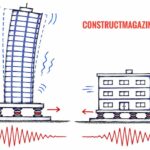
Seismic Base Isolator - Tall vs. Short Building

Introduction In structural engineering and real estate development, base isolation is often presented as the ultimate solution for earthquake-resistant buildings. It is true that by decoupling a structure from the ground, it significantly reduces the seismic forces transmitted into the building during an earthquake. However, the belief that base isolation is always the superior choice is a common misconception. While it is an exceptional solution […] Read More

Critical Unsupported Height in Clays -

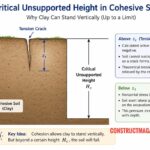
Clay Tension Zone and Unsupported Free Height ( Critical Depth)

Critical Unsupported Height in Cohesive Soils: Understanding the Factor 4 and Why Engineers Are Cautious About Cohesion Note for our non-engineer readers: This article contains a few engineering equations. However, the main concepts can still be understood by reading the text alone, so feel free to skip the math if you wish. One of the most interesting concepts in geotechnical engineering is the critical unsupported […] Read More

Piles or Ground Improvement for Onshore Temp Works? -

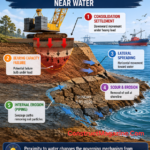
Governing Foundation Failure Modes Onshore

Deep Piles or Ground Improvement? Temporary Heavy-Load Foundations on Expansive Soil Near Water When engineers must support heavy temporary loads in a confined shoreline area, one common question arises: Should we use deep piles, or a shallow foundation with ground improvement? At first glance, deep piles may appear to be the obvious answer, especially when expansive soils and nearby water are involved. However, real geotechnical […] Read More

Failures in Geotechnical Engineering -

Geotechnical engineering is one of the five main branches in civil engineering, which can further be categorized into soil mechanics, foundation engineering, retaining structures and excavations. Geotechnical engineering is a branch that interacts with all other branches, after all, every structure needs foundation system. Geotechnical engineering failures are usually among the costliest to fix, if the fix is possible at all in the first place. […] Read More

The Hidden “Spring” in the Ground -

Conceptual Image Showing Driven Pile Residual Stress

The Hidden “Spring” in the Ground: Understanding Residual Stress in Driven Piles When a pile is driven into the ground, it isn’t just a piece of concrete or steel sitting passively in the dirt. It is a massive, pre-loaded system—essentially a giant elastic spring trapped in a “tug-of-war” with the surrounding soil. For decades, engineers often ignored this internal struggle, but modern deep foundation analysis […] Read More

Welder shortage: Can Robots Save us Quick Enough? -

Welding Industry Stats

According to stats published by AWS – American Welding Society, 320,000 welders will be needed in the US by 2029. The American welding industry is currently at a critical turning point as a massive wave of retirements meets an increasing demand for new infrastructure and manufacturing. In 2024, there were approximately 771,000 professionals working in the trade across the United States. However, more than 157,000 […] Read More

Retaining Structures and Types -

Gravity Retaining Wall

The primary functions of a retaining structure are: Separate an area of low elevation from an adjacent higher elevation area Prevent slope failure or soil movementCreate usable land on sloped terrainSupport excavationsProtect infrastructure such as roads and buildings Retaining structures do this by resisting lateral earth pressure generated by the retained soil or prevent it from collapsing by anchoring into them or reinforcing them. In […] Read More

Factors that affect initial decision about a project -

Conceptual image showing items that affect initial project decision making

A construction project arises from an entity’s need to build something. No matter what the project type and size, there are certain variables that always apply, during the earliest decision making about that project, as far as its scope and size. These factors include but no limited to: The items above apply to any type and size of project. For large scale projects, socioeconomical, administrative, […] Read More