Piles or Ground Improvement for Onshore Temp Works?
Deep Piles or Ground Improvement? Temporary Heavy-Load Foundations on Expansive Soil Near Water
When engineers must support heavy temporary loads in a confined shoreline area, one common question arises:
Should we use deep piles, or a shallow foundation with ground improvement?
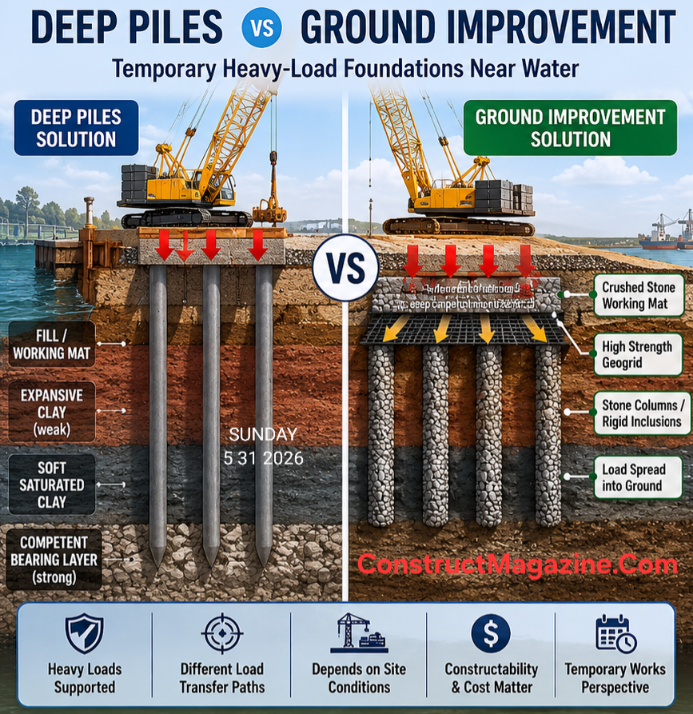
At first glance, deep piles may appear to be the obvious answer, especially when expansive soils and nearby water are involved. However, real geotechnical engineering decisions are rarely that simple.
The Real Problem Is Not Just “Expansive Soil”
Expansive clays are known for shrinking and swelling as moisture conditions change. This can cause:
heave,
settlement,
cracking,
differential movement.
However, near water, the engineering challenge may change completely.
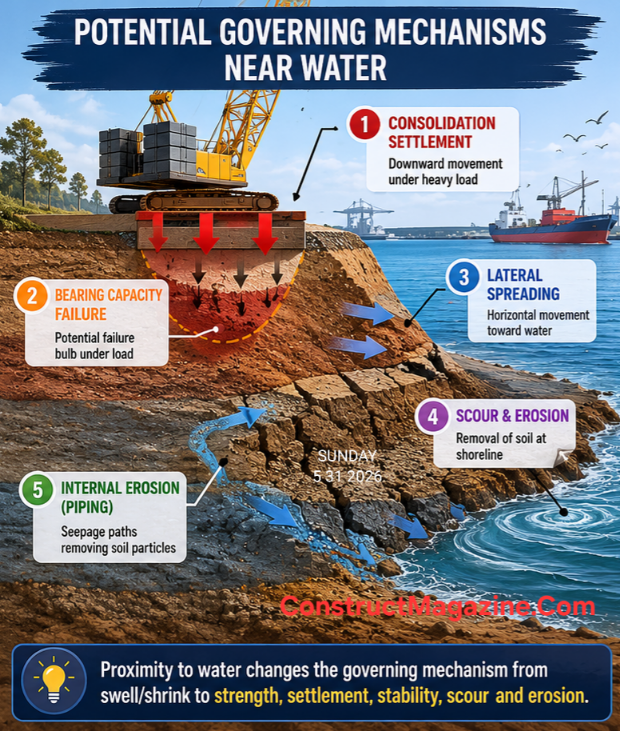
If the soil remains close to saturation for most of the year, seasonal moisture fluctuations may become less important. Instead, the governing design concerns may shift toward:
low undrained shear strength,
consolidation settlement,
bearing capacity failure,
lateral spreading,
scour and erosion,
internal erosion mechanisms.
This distinction is critical because the foundation solution must address the actual governing failure mechanism, not simply the soil classification. Too often, engineers focus on the soil classification itself and overlook the failure mode that is most likely to control performance during the temporary service period. This can result in foundation systems that are more costly than necessary.
Why Deep Piles Are Often Preferred
Deep piles bypass problematic upper soils and transfer loads to deeper, more competent layers.
They can offer:
improved long-term settlement control,
reduced sensitivity to moisture variations,
improved performance under heavy loads,
better resistance to localized scour,
access to stronger bearing strata at depth.
For shoreline projects with severe ground conditions, piles may provide a substantial safety margin.
However, this does not automatically mean they are the best solution.
The Hidden Challenges of Piles in Limited Shoreline Space
What about when we have limited construction space at that shore area? In many temporary projects, constructability can influence the decision as much as theoretical foundation capacity.
Limited site space may create significant challenges during pile installation:
large pile rigs may not fit,
crane access may be restricted,
working platforms may become unstable,
vibrations may affect nearby structures,
mobilization costs may become excessive.
These are important considerations because theoretically optimal pile solutions can become difficult and expensive to construct when site constraints are ignored. In some cases, constructability challenges can ultimately drive project costs more than the foundation capacity itself.
In certain situations, additional geotechnical considerations may also arise, including downdrag effects caused by settlement of surrounding soils.
Near water, piles can also face:
corrosion concerns,
increased unsupported length after scour,
significant lateral loading demands.
For temporary works, these factors can strongly affect overall project economics.
Why Ground Improvement Is Commonly Used
Many temporary heavy-load platforms are successfully constructed using:
geogrid-reinforced platforms,
crushed stone working mats,
soil stabilization,
stone columns,
load transfer platforms,
geocells,
staged construction techniques.
These systems can perform extremely well when:
settlement tolerances are acceptable,
loads are distributed properly,
construction duration is limited,
differential movement is controlled.
In temporary construction, some total settlement may be acceptable if it remains predictable and manageable.
This is one of the primary reasons why shallow solutions are frequently selected in practice.
For ground improvement solutions on soft soils, instrumentation and monitoring can also play a critical role. Settlement plates, inclinometers, piezometers, and survey monitoring can provide valuable performance data during construction and operation. In some temporary works projects, observational methods and real-world measurements may provide greater confidence than simply increasing conservatism in the design.
Temporary Structures Change the Design Philosophy
A temporary structure does not always require the same performance criteria as a permanent facility.
Engineers may allow:
larger settlements,
periodic releveling,
maintenance during service,
shorter design life assumptions.
As a result, a shallow improved platform may become far more economical than deep foundations, even if it experiences greater movement.
The objective is often not to eliminate all settlement, but to maintain acceptable and predictable performance throughout the temporary service period.
The industry frequently applies permanent-structure design philosophy to temporary works. Allowing manageable settlement, periodic releveling, and shorter design life assumptions can unlock significant cost and schedule savings. Many contractors recognize this reality through experience, but incorporating it into the design process remains a challenge on some projects.
The Most Important Question: What Lies Beneath?
The final decision depends heavily on subsurface conditions.
Examples:
If competent soil exists at shallow depth, piles may become attractive.
If weak compressible soil extends very deep, piling may become extremely expensive.
If the site contains soft saturated clays, ground improvement combined with staged construction may offer better overall practicality.
Without a detailed geotechnical investigation, it is impossible to confidently recommend one system over the other.
In Real Projects, Hybrid Solutions Are Common
Actual projects often combine both approaches:
shallow foundations on improved ground,
short piles with reinforced platforms,
localized piling under critical equipment zones,
staged embankment construction with geosynthetics,
load transfer platforms incorporating stone columns or rigid inclusions.
The “pile versus shallow foundation” debate is rarely black and white.
Final Thoughts
For temporary heavy-load structures near water on expansive soil, the best solution is not determined by a single factor such as soil type alone.
The design must balance:
geotechnical performance,
constructability,
allowable settlement,
project duration,
scour risk,
site access,
construction sequence,
overall cost.
In many cases, the most successful design is the one that achieves acceptable performance with the simplest and most constructible solution—not necessarily the most conservative one.
The winning design is rarely the one with the highest theoretical safety margin. More often, it is the solution that safely delivers the required performance while remaining practical, economical, and efficient to construct.
Post By: Ahmet Tuter
Terms of Use: Unauthorized copying is prohibited; we maintain dated records to document original publication. Content may contain inaccuracies. See our Terms Page.