Critical Unsupported Height in Clays
Critical Unsupported Height in Cohesive Soils: Understanding the Factor 4 and Why Engineers Are Cautious About Cohesion
Note for our non-engineer readers: This article contains a few engineering equations. However, the main concepts can still be understood by reading the text alone, so feel free to skip the math if you wish.
One of the most interesting concepts in geotechnical engineering is the critical unsupported height of a cohesive soil. Unlike sand, which typically collapses when excavated vertically, cohesive soils such as clay can often stand nearly vertical for a period of time without support.
This naturally raises an important question:
How high can a vertical cut remain stable, and why does the well-known equation contain the factor 4?
The answer lies in the interaction between soil weight, cohesion, active earth pressure, and the formation of tension cracks.
Why Some Soils Can Stand Vertically
A cohesionless soil such as clean sand derives its shear strength primarily from internal friction.
$$ \tau = \sigma \tan \phi $$
where:
τ = shear strength
σ = normal stress
φ = angle of internal friction
Since sand has little or no cohesion, it cannot maintain a vertical face for any significant height. If excavated vertically, it will typically collapse until it reaches a stable slope angle.
Cohesive soils behave differently. Their shear strength is commonly represented by the Mohr-Coulomb equation:
$$ \tau = c + \sigma \tan \phi $$
where:
c = cohesion
σ = normal stress
φ = angle of internal friction
The cohesion term provides shear strength even when normal stress is very small, allowing cohesive soils to temporarily stand at much steeper angles than sands.
Active Earth Pressure in Cohesive Soils
Rankine’s active earth pressure equation for a cohesive-frictional soil is:
$$ \sigma_h = K_a \sigma_v – 2c\sqrt{K_a} $$
where:
σh = horizontal active stress
σv = vertical stress
c = cohesion
Ka = active earth pressure coefficient
The active earth pressure coefficient is:
$$ K_a = \tan^2\left(45^\circ-\frac{\phi}{2}\right) $$
The first term represents lateral pressure generated by the weight of the soil. The second term represents the reduction in active pressure caused by cohesion. In simple terms, cohesion acts against the tendency of the soil to move laterally.
Why Tension Cracks Form
Vertical stress increases with depth:
$$ \sigma_v = \gamma z $$
where:
γ = unit weight of soil
z = depth
Substituting into Rankine’s equation gives:
$$ \sigma_h = K_a\gamma z – 2c\sqrt{K_a} $$
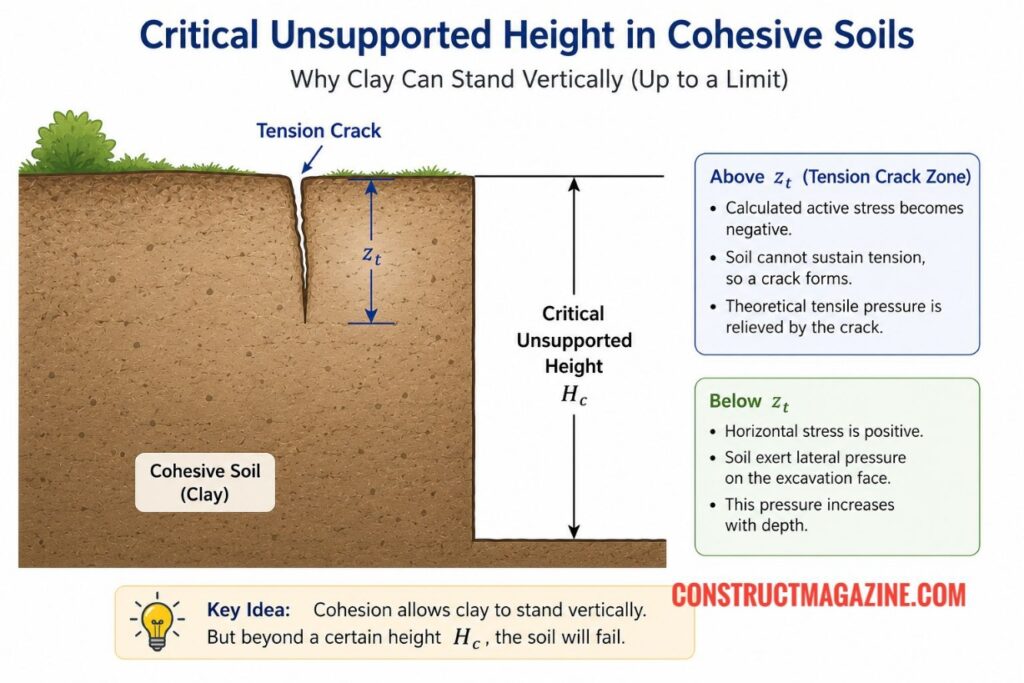
Near the ground surface, the cohesion term may exceed the stress generated by the soil’s self-weight. As a result, the equation may predict negative horizontal stresses.
For example:
$$ \sigma_h = -20 \text{ kPa} $$
This creates a problem because soil can push, but it cannot sustain significant tension.
A negative horizontal stress would imply that one portion of the soil is pulling on another. Since soil cannot maintain such tensile stresses, a crack forms instead.
This crack is known as a tension crack.
Deriving the Tension Crack Depth
The tension crack extends downward until the horizontal stress becomes zero.
Setting:
$$ \sigma_h = 0 $$
gives:
$$ 0 = K_a\gamma z_t – 2c\sqrt{K_a} $$
Solving for depth:
$$ z_t = \frac{2c}{\gamma\sqrt{K_a}} $$
where zt is the tension crack depth.
Above this depth, the theoretical active stress is negative and cannot exist. The soil relieves this tension by cracking. Below this depth, the soil begins exerting positive active pressure.
The Special Case of Undrained Clay
For short-term undrained clay conditions:
$$ \phi = 0 $$
Therefore:
$$ K_a = 1 $$
The tension crack equation becomes:
$$ z_t = \frac{2c}{\gamma} $$
Why Is Ka = 1?
In undrained clay analysis, the friction angle is assumed to be zero. Using Rankine’s equation:
$$ K_a = \tan^2(45^\circ) $$
which equals 1.
This does not mean the clay has no strength. The clay’s shear strength is represented by the undrained cohesion, c. Using Ka = 1 simply makes the derivation easier and leads to the well-known critical height equation.
The Origin of the Factor 4
The famous equation for critical unsupported height is:
$$ H_c = \frac{4c}{\gamma\sqrt{K_a}} $$
For pure undrained clay:
$$ H_c = \frac{4c}{\gamma} $$
Many students memorize this equation without understanding where the factor 4 originates.
The key relationship is:
$$ H_c = 2z_t $$
In other words, the critical unsupported height is twice the tension crack depth.
Substituting the tension crack equation:
$$ H_c = 2\left(\frac{2c}{\gamma\sqrt{K_a}}\right) $$
which simplifies to:
$$ H_c = \frac{4c}{\gamma\sqrt{K_a}} $$
Therefore:
$$ 4 = 2 \times 2 $$
The first factor 2 comes from the derivation of the tension crack depth.
The second factor 2 comes from the fact that the critical unsupported height is twice the tension crack depth at the limiting equilibrium condition.
This is the physical origin of the famous factor 4.
Worked Example
Suppose an undrained clay has:
- Cohesion, c = 25 kPa
- Unit weight, γ = 18 kN/m³
- Friction angle, φ = 0°
Since φ = 0°:
$$ K_a = 1 $$
Step 1: Calculate the Tension Crack Depth
$$ z_t = \frac{2c}{\gamma} $$
$$ z_t = \frac{2(25)}{18} $$
$$ z_t = 2.78 \text{ m} $$
A tension crack may therefore extend approximately 2.8 m below the ground surface.
Step 2: Calculate the Critical Unsupported Height
$$ H_c = \frac{4c}{\gamma} $$
$$ H_c = \frac{4(25)}{18} $$
$$ H_c = 5.56 \text{ m} $$
The theoretical maximum unsupported vertical height is therefore about 5.6 m.
Notice that:
$$ H_c \approx 2z_t $$
which is exactly what the theory predicts.
Physical Interpretation
Consider a vertical excavation in clay.
At small depths:
- The soil wedge is relatively light.
- Cohesion can resist movement.
- The excavation remains stable.
As excavation becomes deeper:
- The potential failure wedge becomes heavier.
- Driving forces increase.
- Shear stresses along the failure surface increase.
Eventually a point is reached where:
Driving Forces = Resisting Forces
At this limiting condition, the excavation has reached its critical unsupported height.
Beyond this height, failure becomes inevitable.
Cohesion, Friction, and the Active Wedge
A common misconception is that the active wedge depends only on the friction angle.
For purely frictional soils such as sand, the active failure mechanism is largely controlled by φ.
However, cohesive-frictional soils behave differently.
In such soils:
- Friction contributes to resistance.
- Cohesion contributes to resistance.
- Active pressures are reduced by cohesion.
- Tension cracks may develop.
- Failure mechanisms can differ significantly from those predicted for sands.
Therefore, the behavior of cohesive soils cannot be described using friction angle alone.
Why Engineers Are Cautious About Cohesion
Although the equations predict impressive unsupported heights, practicing geotechnical engineers are often reluctant to rely heavily on cohesion for permanent structures.
Several factors can reduce cohesion over time.
Cracking
Natural shrinkage and weathering can create cracks that weaken the soil mass.
Rainfall
Water may enter tension cracks and generate hydrostatic pressure that pushes the soil outward.
Wetting and Drying Cycles
Repeated moisture changes can degrade cohesive bonds.
Creep
Clay soils exhibit time-dependent deformation. A cut that appears stable immediately after excavation may fail days, weeks, months, or even years later.
Weathering
Long-term environmental exposure can reduce cohesive strength.
Temporary Versus Permanent Design
This distinction is extremely important.
Temporary Excavations
For temporary works:
- Short-term undrained strength is often used.
- Cohesion is commonly relied upon.
- Steep cuts may be acceptable for limited periods.
Permanent Structures
For long-term stability assessments:
- Engineers often reduce cohesion values.
- Sensitivity studies may assume lower cohesion.
- Friction angle is generally considered more reliable.
- Some analyses assume zero effective cohesion.
This conservative approach helps ensure that long-term performance does not depend on strength that may diminish over time.
A Practical Engineering Philosophy
Many geotechnical engineers summarize the issue with a simple statement:
“Friction is forever; cohesion is a bonus.”
While this statement is an oversimplification, it reflects an important design philosophy.
Frictional resistance tends to remain available throughout the life of a structure. Cohesion, on the other hand, may decrease because of cracking, weathering, moisture changes, and other long-term effects.
For this reason, critical unsupported height calculations provide valuable insight into soil behavior, but they should never be interpreted as a guarantee that a vertical cut will remain stable indefinitely.
Conclusion
The critical unsupported height of a cohesive soil is one of the most important concepts in earth pressure theory. It explains why clays can temporarily stand vertically while sands generally cannot.
The famous equation:
$$ H_c = \frac{4c}{\gamma\sqrt{K_a}} $$
is directly related to the development of tension cracks and the limiting equilibrium of the potential failure wedge.
The factor 4 is not arbitrary. It arises because the critical unsupported height is twice the tension crack depth, and the tension crack depth itself contains a factor of 2.
Although these equations predict substantial unsupported heights, engineers must recognize that cohesion can diminish over time. Cracking, rainfall, creep, weathering, and long-term environmental effects can all reduce stability.
Consequently, permanent geotechnical designs often rely more heavily on frictional resistance and treat cohesion conservatively.
By: A. Tuter
Terms of Use: Unauthorized copying is prohibited; we maintain dated records to document original publication. Content may contain inaccuracies. See our Terms Page.