The Hidden “Spring” in the Ground
The Hidden “Spring” in the Ground: Understanding Residual Stress in Driven Piles
When a pile is driven into the ground, it isn’t just a piece of concrete or steel sitting passively in the dirt. It is a massive, pre-loaded system—essentially a giant elastic spring trapped in a “tug-of-war” with the surrounding soil. For decades, engineers often ignored this internal struggle, but modern deep foundation analysis reveals that ignoring residual stress can lead to a fundamental misunderstanding of how a pile actually supports a building and the soil properties surrounding the pile. For large scale or some sensitive ground projects this can be critical.
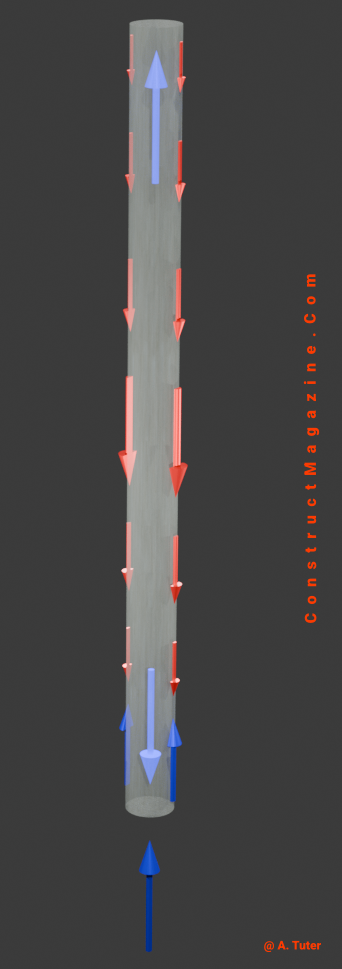
The Physics: The Trapped Spring
To understand residual stress, you have to look at what happens during hammer blows. When the hammer strikes the pile, the material (concrete or steel) is compressed elastically. It physically shortens under the force. This effect accumulates with each hammer blow. To be more precise, each blow creates transient stress waves, and residual stress develops progressively as permanent soil resistance mobilizes and elastic rebound becomes restrained.
Once the impact is over, that compressed material wants to return to its original length—it wants to elongate. However, it is no longer in open air; it is gripped by the soil around it and resisted from below.
At the bottom shorter portion: The pile’s desire to stretch downward is met by the unyielding resistance of the pile tip (the “toe”) against the hard soil or rock. Because it is blocked from moving down, this bottom section of the pile stays in a state of compression and the pile wants to pull the surrounding soil downwards. Note: We said bottom “shorter” portion because the upper tensile zone often occupies a much larger portion of the pile length, while the compressive residual zone at the bottom is usually more concentrated near the toe.
At the longer upper portion: The pile’s desire to stretch upward is met by the friction of the upper soil layers. The soil “grips” the shaft and pulls down, refusing to let the pile rebound to its original height. This leaves the upper pile material in a state of tension (it is being stretched), so the pile wants to pull the surrounding soil upwards.
Residual stresses are often most pronounced in dense sands and other stiff soils that strongly restrain the pile’s elastic rebound, while very soft clays generally allow more relaxation of these locked-in stresses over time.
We can measure and understand these effects by installing strain gages (sensors) along the pile.
The Overestimated Shaft (longer, upper part)
Because the pile is already “tugging upward” on the upper soil layers, our downward test load has to first “cancel out” that upward pull before the soil even begins to resist the test in a normal way. To the engineer watching the computer screen, it looks like we are applying a lot of force with very little movement.
The Error: We record a very high value for skin friction. We think the shaft is a “superhero” carrying the bulk of the load, when in reality, we were just fighting the pre-existing residual tension.
The Underestimated Toe (shorter, lower part)
At the bottom, the situation is reversed. The pile is already pressing down on the soil at the tip. It is “pre-activated.” As we add test load, the soil yielding is reached sooner.
The Error: To the sensors, it looks like the tip “gave up” quickly. We record a low value for end bearing. We think the soil at the tip is weak, failing to realize it was already doing a non-negligible portion of its work before we even started the clock.
Why Accuracy Matters: The Real-World Risks
If you only measure the total capacity of the pile (the total weight at the top), you will get the correct answer. The total is the total, it doesn’t change. But if you rely on the uncorrected gages to tell you “where” that strength is coming from, it is a risky bet.
Scour and Environmental Changes: If a flood or erosion washes away the upper 20 feet of soil, you lose the shaft friction you were counting on. If you overestimated that friction, the pile may no longer be safe.
Settlement Predictions: Piles that rely on end bearing behave differently than those that rely on friction. If your data wrongly tells you the pile is a “friction pile” when it is actually a “toe-bearing pile,” your predictions for how much the building will settle over 20 years will be fundamentally wrong.
Correcting the Math
To fix this, engineers use methods like the Fellenius Method. By zeroing the gages “before” the pile is even handled, and by carefully watching how the pile “unsprings” during the unloading phase of a test, we can calculate the “hidden” residual loads. And avoid underestimating end bearing and overestimating skin friction. By shifting the data to account for these “trapped” stresses, we move from a “false” distribution to a “true” distribution. This ensures that when we sign off on a design, we know exactly which soil layer is doing the work, making the foundation not just strong, but predictable.
The “So What?” Factor: Why “Over” and “Under” Estimation Actually Matter
And if what we get is the reality that includes these residual stresses, then why do we bother calling it over- or underestimated? After all, that is the physical state of the pile in the ground. Why not just accept the measurements as the “real-world” capacity?
This first reason is because we are trying to separate the “permanent strength of the earth” from the “temporary mechanical effects of the hammer”. Such as:
- The Risk of Stress Relaxation: Residual stress is a byproduct of the violent, dynamic impact of a hammer. While it is “real” the moment the pile is driven, it is not necessarily permanent. Over the 50- or 100-year lifespan of a building, several factors can cause that “trapped spring” to relax.
- Soil Creep: Soil is not a perfectly elastic material; it can slowly deform or “flow” around the pile over decades.
- Vibrations and Seismic Events: Ground shaking from earthquakes, heavy traffic, or nearby construction can “un-stick” the friction holding the spring in place.
If that internal tug-of-war relaxes over time, the “extra” capacity you thought you had in the shaft (the overestimation) simply disappears. By correcting the data, we ensure the design is based on the soil’s long-term, stable state rather than a temporary installation artifact.
We also use the pile as a probe for the whole site. When we perform a load test, we aren’t just testing that one pile; we are using it to verify the soil properties for the entire project site. If we don’t correct for residual stress, we end up assigning imaginary properties to the soil that don’t actually exist. For example if the uncorrected gages say the clay at 20 feet is incredibly strong (due to residual tension), you might use those values to design the rest of the foundation. But if you decide to use a “Bored Pile (Drilled Shaft)” for another part of the structure, that pile will have negligible driven-pile-type residual stress. If you used the “uncorrected” friction values for the bored pile design, it would likely fail because you assigned a strength to the soil that actually belonged to the hammer’s impact.
Safety factors and Hidden Vulnerabilities
Engineering is about managing “what-if” scenarios. If a river scours away the top layers of soil, you need to know exactly how much the tip (the toe) can carry alone. If your test data underestimated the tip strength, you might conclude the bridge is at risk when it isn’t—or worse, if you overestimated the shaft strength, you might think you have a massive safety buffer that evaporates as soon as the soil is removed.
When Can Residual Stress Be Safely Ignored?
On standard construction projects, engineers are often able to safely ignore residual stress because their design methodology relies primarily on the total ultimate capacity of the pile rather than a precise layer-by-layer breakdown of shaft and toe resistance. During a routine uninstrumented static load test, the pile is pushed from the top until it physically plunges or reaches its failure criterion, and this large external loading overwhelms the comparatively smaller internal residual balance, making the measured top-load response a reliable representation of the pile’s gross load-carrying capacity. Even if an earthquake or long-term soil creep gradually relaxes some of the pile’s locked-in residual stresses over time, the surrounding soil layers on an ordinary stable site generally remain structurally intact; in many cases, the lost residual effects simply redistribute within the overall soil-pile system without significantly changing the foundation’s total capacity.
However, nature does not care whether a project is a small warehouse or a billion-dollar bridge. Severe hazards such as seismic liquefaction or river scour can occur on projects of any size. The real turning point is not the budget of the project, but how the engineer chooses to design for these hazards. If the engineer takes a conservative approach—treating liquefiable or scour-prone upper soils as structurally unreliable and driving the pile deep into a competent bearing layer while designing mainly around the pile’s total ultimate capacity—then residual stress can often still be safely ignored. But the moment an engineer attempts to optimize the design by using strain gages to determine exactly where the resistance is coming from, ignoring residual stress becomes a critical mathematical error.
Post By: Ahmet Tuter
Terms of Use: Unauthorized copying is prohibited; we maintain dated records to document original publication. Content may contain inaccuracies. See our Terms Page.