Welder shortage: Can Robots Save us Quick Enough?
According to stats published by AWS – American Welding Society, 320,000 welders will be needed in the US by 2029.
The American welding industry is currently at a critical turning point as a massive wave of retirements meets an increasing demand for new infrastructure and manufacturing. In 2024, there were approximately 771,000 professionals working in the trade across the United States. However, more than 157,000 of these experienced workers are now reaching retirement age. To keep up with growth and replace those leaving the field, projections show that the country will need to find 320,500 new welders by the year 2029.
Most of these professionals are concentrated in a few key sectors. Manufacturing is the primary employer, providing jobs for 61 percent of the workforce. Specialty trade contractors account for 8 percent of the industry, while repair and maintenance work covers about 4 percent. These figures highlight how essential welding remains to the broader industrial economy.
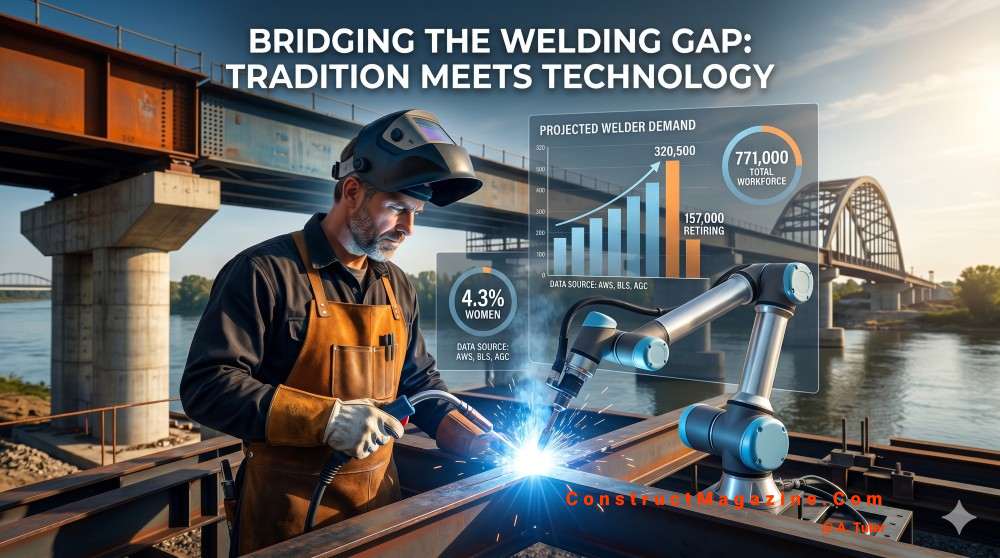
The nature of the job is also evolving due to new technology. Automated and robotic welding systems are quickly becoming the industry standard. This change is creating a need for a new kind of hybrid worker who can combine traditional manual skills with the technical knowledge required to program and manage robotic equipment. For the construction and manufacturing industries to succeed in the coming years, they will need to focus on training a workforce that is comfortable with both high-tech tools and hands-on craftsmanship.
Data above sourced from the American Welding Society Welding Digest.
Now let’s look at some relevant facts about welding industry:
Median Annual Pay: As of May 2024, the median annual wage for welders, cutters, solderers, and brazers in the U.S. was $51,000, which is higher than the median for all occupations ($49,500). (Source: U.S. Bureau of Labor Statistics)
Top Industry Earnings: Welders working for “Specialty Trade Contractors”—the sector most relevant to construction—earn a higher median wage of $57,310. (Source: U.S. Bureau of Labor Statistics)
Project Delays: Approximately 70% of construction firms have reported project delays specifically tied to workforce constraints and a lack of available craft workers. (Source: Associated General Contractors of America / ABC Carolinas)
Widespread Recruitment Struggles: A staggering 92% of hiring firms reported difficulty finding qualified workers last year, leading to bottlenecks in the construction of factories, healthcare facilities, and housing. (Source: Associated General Contractors of America)
Women in the Trades: While the number of women in construction trades is at a historic high of 366,360, they still represent only 4.3% of the total workforce in these roles. (Source: Institute for Women’s Policy Research)
Advanced Technology and Training
AR Training Realism: Research comparing training methods found that Augmented Reality (AR) is rated significantly more realistic (4.13 out of 5) than Virtual Reality (2.55 out of 5) for transferring skills to real-world welding tasks. (Source: Scientific Papers of Silesian University of Technology, 2025)
The Rise of Cobots: Collaborative robots (cobots) are being deployed in 2025 to work alongside humans, specifically to handle repetitive positioning tasks and help small to mid-sized businesses mitigate labor shortages. (Source: Crossfire Welders / Decapower)
Laser Welding Precision: Handheld laser welders are becoming a mainstay for on-site repairs in 2025 because they offer high-speed welding with minimal heat distortion compared to traditional methods. (Source: Crossfire Welders)
Smart Welding (IoT): Modern welding machines are now equipped with IoT sensors that monitor arc stability, temperature, and pressure in real-time to predict maintenance needs and prevent material waste. (Source: Decapower)
Federal Project Surge: The Bipartisan Infrastructure Law has already funded over 60,000 projects nationwide, creating a massive localized demand for welders to repair thousands of bridges and public works. (Source: U.S. Department of Transportation)
Post By: A. Tuter
Terms of Use: Unauthorized copying is prohibited; we maintain dated records to document original publication. Content may contain inaccuracies. All trademarks mentioned belong to their respective owners; we are not affiliated with them, and no endorsement is implied. See our Terms Page.