Should Foundation Beams Rely on Soil Support?
One of the most common debates in foundation engineering is whether a foundation beam should be analyzed with soil support or as a suspended beam spanning only between its supports. Neither approach is universally correct; the appropriate choice depends on the beam’s function, the foundation system, and the expected behavior of the supporting soil.
Before discussing the analysis, it is important to clarify terminology. Although the terms are sometimes used interchangeably, a structural grade beam and a tie beam do not always serve the same purpose. A structural grade beam primarily transfers vertical loads from walls or columns to foundations, while a tie beam mainly connects individual foundations, improving structural integrity and resisting axial forces caused by differential movement or seismic actions. In some projects, a single reinforced concrete member performs both functions.
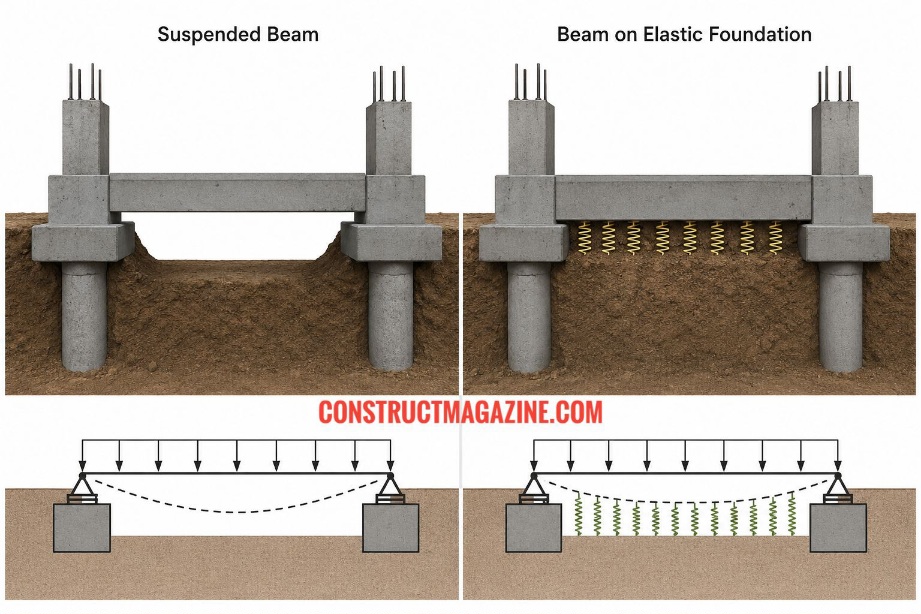
A widely used conservative approach is to ignore the soil beneath the beam entirely. The beam is analyzed as a conventional reinforced concrete beam spanning between footings, pile caps, or drilled piers, with no vertical support from the soil.
This method is commonly adopted for deep foundation systems, expansive soils, or sites where settlement could reduce soil support over time. By assuming the ground provides no assistance, the beam remains capable of carrying its design loads even if the soil settles, shrinks, erodes, or loses contact with the concrete.
In expansive clay regions, engineers often install void forms beneath suspended beams to prevent swelling soil from exerting upward pressure. Biodegradable cardboard forms decompose after construction, leaving a true air gap beneath the beam. Expanded polystyrene (EPS) forms remain in place and compress under soil expansion, reducing—though not eliminating—the upward pressure.
Another common approach is to include soil support in the structural model. The beam is assumed to rest on a continuous series of elastic springs representing the ground, commonly known as the Winkler or beam-on-elastic-foundation model. This method is appropriate when the supporting soil is well characterized, stable, and expected to maintain its bearing capacity, particularly when the beam is intended to share loads with the surrounding soil.
Including soil support generally reduces bending moments and shear forces because part of the load is transferred directly into the ground. However, this advantage depends on the soil continuing to provide the assumed support. If settlement, consolidation, erosion, or future excavation changes the soil conditions, the beam’s internal forces may increase significantly.
Modern structural software has made this modeling choice remarkably easy. Programs such as ETABS, SAP2000, and SAFE allow engineers to assign soil springs with only a few clicks. While convenient, this can create a false sense of confidence if the design assumes permanent soil support without evaluating what happens if that support is lost. For this reason, many engineers also analyze a suspended-beam condition or compare multiple analytical models.
Reinforced concrete design codes generally do not prescribe which analytical model must be used. Standards such as ACI 318 specify how to design the concrete member once bending moments, shear forces, torsion, and axial forces have been determined, but they leave the choice of structural model to the engineer. Depending on their geometry, some foundation beams may also qualify as deep beams, while beams supporting eccentric loads may require torsional design in addition to flexure and shear.
Ultimately, there is no universal international code requiring every foundation beam to be analyzed either with or without soil support. The appropriate model depends on the beam’s structural function, the anticipated long-term behavior of the supporting soil, and sound engineering judgment supported by reliable geotechnical information.
Post By: A.Tuter
Terms of Use: Unauthorized copying is prohibited; we maintain dated records to document original publication. Content may contain inaccuracies. See our Terms Page.