Cold Joints in Concrete: Causes, Prevention, Fixes
Cold joints are one of the most common quality issues encountered during concrete placement. They occur when fresh concrete is placed against concrete that has already begun to set, preventing the two layers from bonding into a single, monolithic element. Although a cold joint doesn’t always necessarily mean a structural failure, it can reduce strength, increase permeability, and create long-term durability concerns.
Understanding Initial Set
The risk of a cold joint depends on concrete setting, not simply elapsed time. Time is only a factor in Setting. Setting is a chemical reaction influenced by time, temperature, mix design, and admixtures. According to ASTM C403, initial set occurs when mortar reaches penetration resistance of 500 psi (3.5 MPa). Before this point, proper vibration can consolidate successive lifts into a continuous mass. Once the underlying concrete reaches initial set, effective consolidation is generally no longer possible, greatly increasing the likelihood of a cold joint.
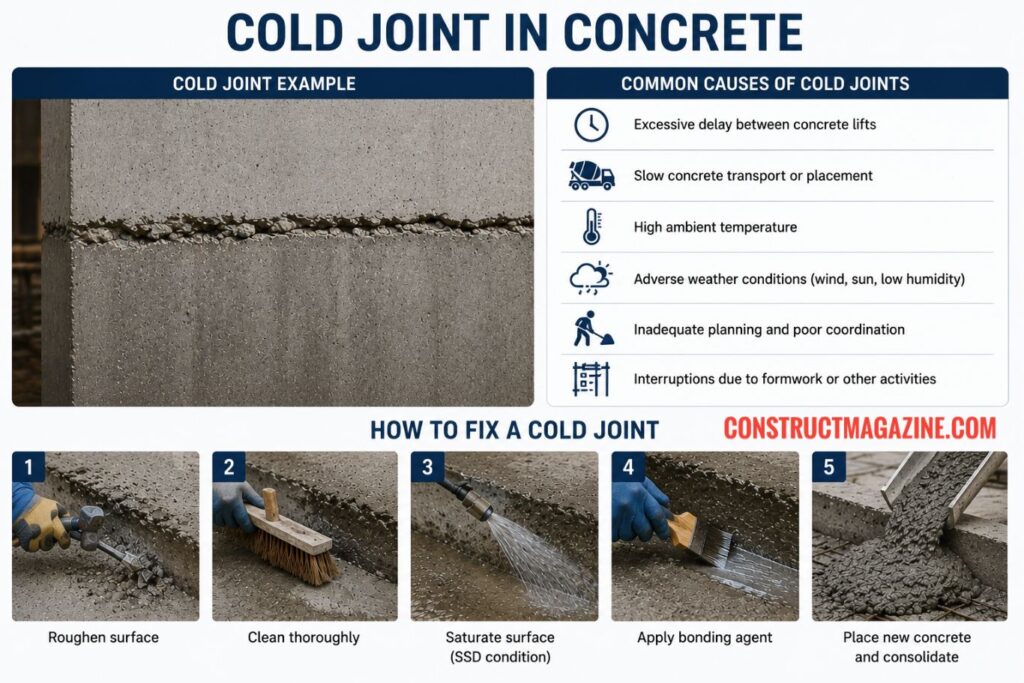
What Causes Cold Joints?
Cold joints usually result from excessive delays between concrete placements. Common causes include:
- Concrete delivery delays
- Pump or equipment failures
- Insufficient labor or poor planning
- Long transportation times
- Unexpected weather conditions
Hot weather increases the risk by accelerating hydration and shortening the available placement time.
How to Prevent Cold Joints
Successful prevention begins before the first truck arrives.
Plan the pour to ensure adequate manpower, reliable equipment, and a continuous concrete supply. Maintain a steady placement rate so each lift is placed before the underlying concrete reaches initial set.
Concrete should be placed in manageable lifts, allowing internal vibrators to penetrate approximately 100–150 mm (4–6 in.) into the previous lift while it remains plastic. This eliminates trapped air and helps create a strong bond between layers. Note that this number is for the purposes of joining the two layers not the initial vibration of previous layer which is almost all the way without touching forms).
Environmental conditions should also be considered. High concrete temperatures can dramatically reduce working time, while chilled mixing water, ice, or retarding admixtures may extend it. Supplementary cementitious materials such as fly ash or ground granulated blast-furnace slag (GGBFS) can also slow setting and provide longer placement windows when appropriate.
For critical projects, laboratory testing in accordance with ASTM C403 can establish the setting characteristics of a specific mix under anticipated site conditions. Some projects also use maturity monitoring (ASTM C1074). When properly calibrated for the mix design, maturity data can help estimate setting behavior and alert crews when placement delays are approaching critical limits.
What If a Cold Joint Occurs?
If the underlying concrete is still plastic, placement should resume as quickly as possible with thorough vibration to consolidate the interface.
If the concrete has already hardened, the interface should generally be treated as a construction joint rather than simply continuing the pour. Typical preparation includes removing laitance and weak surface material, roughening the surface—often to an ICRI Concrete Surface Profile (CSP) appropriate for the specified repair system, commonly in the CSP 3–6 range—cleaning away dust and debris, bringing the concrete to a saturated surface-dry (SSD) condition, and applying a bonding grout or bonding agent if required by the project specifications.
Repairing Existing Cold Joints
When a cold joint is discovered after the concrete has hardened, the appropriate repair depends on its structural significance. Minor joints may only require sealing to limit water penetration, while more serious cases may require epoxy injection, repair mortars, structural strengthening, or partial removal and replacement. In critical structural members, engineers may perform inspections, core sampling, or non-destructive testing before selecting the repair method.
Final Thoughts
Cold joints are far easier to prevent than to repair. Proper planning, continuous placement, effective vibration, and close monitoring of concrete setting are the best defenses. When unavoidable delays occur, intentionally stopping the pour at a properly prepared construction joint is often preferable to creating an uncontrolled cold joint that may compromise long-term performance.
Needless to say, these are all general information. When you have cold joint, the structural engineer of the project must be notified and the course of action must be decided with his approval.
Posted By: A. Tuter
Terms of Use: Unauthorized copying is prohibited; we maintain dated records to document original publication. Content may contain inaccuracies. See our Terms Page.