Stairs affecting building stiffness in structural analysis
Why Modeling Stairs Can Trigger Soft-Story and Torsional Irregularity Warnings — and How Structural Software Can Improve
Structural engineers occasionally report that a building model behaves normally until reinforced concrete stairs are added, at which point soft-story or torsional irregularity warnings suddenly appear.
Stairs are commonly included in analytical models because they contribute gravity loads, seismic mass, and sometimes structural stiffness. As a result, software must handle stair systems reliably and transparently.
Understanding the Challenge
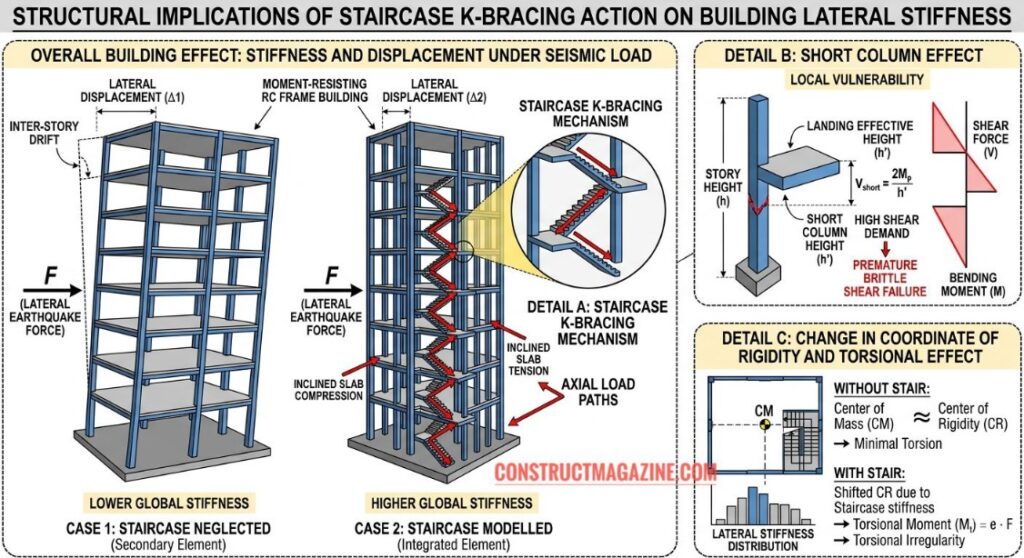
Modern structural analysis programs perform sophisticated 3D finite element analysis, yet certain code checks, including soft-story, story stiffness, drift, and torsional irregularity evaluations, still rely on story-based procedures developed for conventional buildings. Stairs challenge these assumptions by introducing inclined elements and connectivity between multiple stories.
Importantly, the appearance of soft-story or torsional irregularity warnings does not automatically indicate a software bug.
Reinforced concrete stairs can legitimately:
- Increase lateral stiffness.
- Modify mode shapes.
- Change load paths.
- Shift the center of rigidity.
- Influence torsional response.
- Redistribute story drifts.
At the same time, simplified story-based algorithms may misinterpret these effects and generate false positives.
The challenge is distinguishing genuine structural behavior from modeling or post-processing artifacts.
Why Stairs Affect Structural Behavior
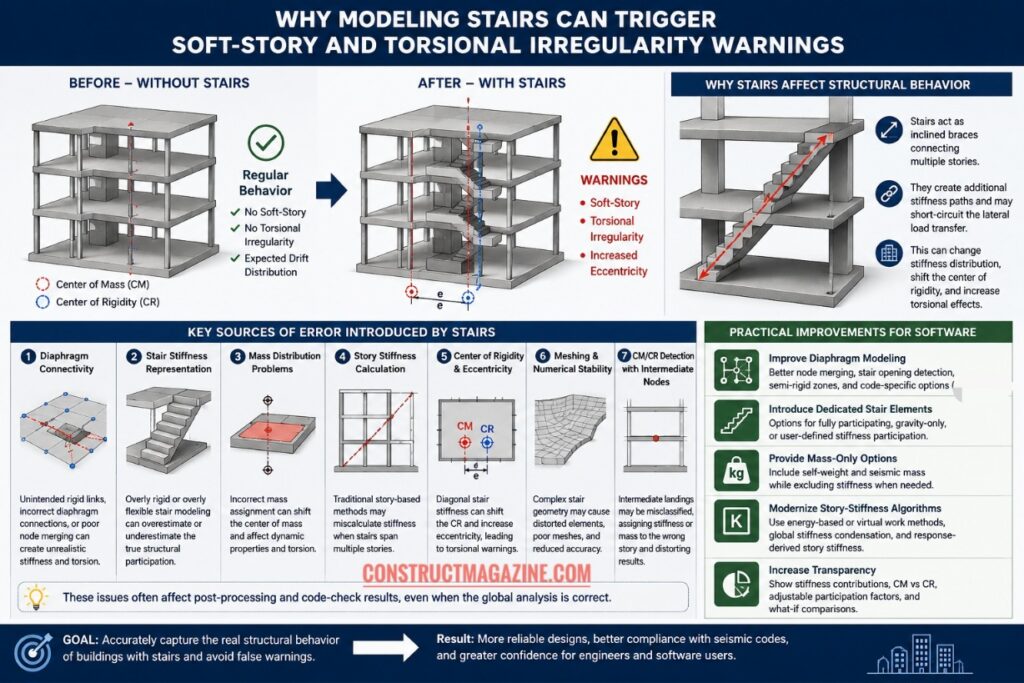
Monolithic reinforced concrete stairs often behave like inclined braces connecting floor levels. When integrated with slabs, beams, walls, and landings, they create additional stiffness paths that may bypass assumptions embedded in traditional story-based checks.
This behavior may be entirely real. However, it can also create “short-circuit” between stories, where forces follow paths not anticipated by simplified code-check routines.
As a result, software may either correctly identify a real change in behavior or incorrectly generate artificial irregularities.
Potential Sources of Error
1. Diaphragm Connectivity Issues
Many programs automatically assign nodes at each floor to a rigid diaphragm.
When stairs intersect these levels, software may:
- Create unintended rigid links.
- Connect diaphragms incorrectly.
- Fail to merge nodes properly.
- Generate unrealistic force-transfer paths.
The result can be exaggerated stiffness and artificial torsional behavior.
2. Incorrect Stair Stiffness Representation
The stiffness assigned to stair elements can significantly influence analysis results. Because stair participation varies between projects and modeling assumptions, software should provide flexible options that allow engineers to control how stair stiffness is represented.
3. Mass Distribution Problems
Stairs contribute significant dead load and seismic mass.
Incorrect mass assignment may:
- Shift the center of mass.
- Alter dynamic characteristics.
- Affect modal participation.
- Influence torsional calculations.
Software should correctly distribute stair mass to the appropriate floor levels and ensure that intermediate landings and inclined stair elements are represented consistently in seismic mass calculations.
4. Story Stiffness Calculation Limitations
Many soft-story checks rely on simplified stiffness calculations developed for conventional vertical systems.
Stairs complicate these procedures because they:
- Span multiple stories.
- Introduce intermediate-height nodes.
- Transfer forces diagonally across story boundaries.
Traditional algorithms may therefore miscalculate equivalent story stiffness.
A more robust solution is to derive story stiffness directly from the global 3D response using energy-based, virtual-work, or equivalent-stiffness methods.
5. Center of Rigidity and Story Eccentricity Calculations
When stairs introduce significant diagonal stiffness, some algorithms may incorrectly estimate:
- Story stiffness distribution.
- Center of rigidity location.
- Torsional eccentricity.
- Accidental torsion amplification factors.
A related issue involves intermediate stair landings. Some post-processing routines may misclassify these nodes, assign stiffness to the wrong story, distort center-of-mass calculations, and miscalculate story eccentricities.
These issues may not affect the global analysis itself but can significantly influence code-check results.
6. Meshing and Numerical Stability
Complex stair geometries may generate:
- Distorted shell elements.
- Poor aspect-ratio meshes.
- Difficult transitions between inclined and horizontal surfaces.
These conditions can reduce numerical accuracy and result quality.
Practical Improvements for Software
Improve Diaphragm Modeling
Software should provide more intelligent handling of stair-to-floor connections through:
- Better node-merging algorithms.
- Automatic stair-opening detection.
- User-selectable connection conditions.
- Improved handling of diaphragm connectivity around stair openings
- Code-specific options aligned with regulations
The goal is to model actual construction behavior rather than universally including or excluding stairs.
Introduce Dedicated Stair Elements
A dedicated staircase element could reduce ambiguity by allowing engineers to define:
- Fully participating stairs.
- Gravity-only stairs.
- User-defined stiffness participation.
- Realistic landing connection conditions.
Provide Mass-Only Options
Engineers may model stairs primarily to capture gravity loads and seismic mass.
Software should allow users to:
- Include self-weight.
- Include seismic mass.
- Exclude stiffness participation when appropriate.
Modernize Story-Stiffness Algorithms
Story stiffness should increasingly be derived from the global 3D model rather than simplified geometric assumptions.
Potential approaches include:
- Global stiffness matrix condensation.
- Virtual force application.
- Energy-based stiffness extraction.
- Response-derived story stiffness calculations.
Users should also be able to compare results with and without stair stiffness participation.
Improve Post-Processing Procedures
A common failure mode is correct global analysis but incorrect code-check post-processing.
Developers should review:
- Soft-story calculations.
- Torsional irregularity checks.
- Story drift computations.
- Center-of-rigidity calculations.
- Story stiffness extraction procedures.
These routines must correctly recognize intermediate stair nodes and multi-story connectivity.
Increase Transparency
Engineers should be able to see exactly how stairs influence the structure.
Useful features include:
- Story stiffness breakdowns by element type.
- Center-of-rigidity versus center-of-mass comparisons.
- Stiffness contribution percentages.
- Adjustable stair participation factors.
- What-if comparison studies.
- Side-by-side results with and without stair participation.
Recommended Temporary Workarounds
- Running models with and without stair stiffness participation.
- Reviewing mode shapes.
- Monitoring center-of-rigidity movement.
- Verifying diaphragm assignments around stair openings.
- Examining story stiffness tables.
- Testing alternative landing connection assumptions.
These checks can help determine whether an irregularity is physical or numerical.
What Is the Most Likely Software Issue?
Modern solvers generally handle inclined shell elements effectively. However, calculations such as story stiffness, soft-story ratios, center-of-rigidity locations, and torsional irregularity coefficients often rely on assumptions that become problematic when elements span multiple stories.
In many cases, the global analysis is correct while the derived code-check metrics become unreliable.
Software should therefore expose raw analysis results alongside derived code-check values for independent verification.
Long-Term Direction
A practical future approach is to combine traditional story-based checks for regular buildings with advanced 3D-derived metrics for structures containing stairs and other irregular features. This could improve accuracy and reduce false irregularity warnings..
Post By: A. Tuter
Terms of Use: Unauthorized copying is prohibited; we maintain dated records to document original publication. Content may contain inaccuracies. See our Terms Page