The Engineering Mastery of Roman Aqueducts
The water distribution system of the Roman Empire was a very remarkable feat of civil engineering. By supplying large volumes of water to urban centers—especially Rome—it enabled populations on an unprecedented scale. At its peak, Rome reached nearly one million residents, supported by a reliable and sophisticated water supply of adequate capacity, bringing water from distances of tens of kilometers away. Structures such as the Pont du Gard in France and the Aqueduct of Los Milagros in Spain demonstrate the durability of these designs.
By the completion of the system, 11 major aqueducts served the city. With a combined length of several hundred kilometers, they delivered an estimated 500,000 to 1,000,000 cubic meters of water per day. This corresponds to several hundred up to roughly 1,000 liters per person per day, though this includes public uses, system losses, and uneven distribution. While some water was used for drinking, much of it supplied public baths, fountains, irrigation, mills, and industrial activities.
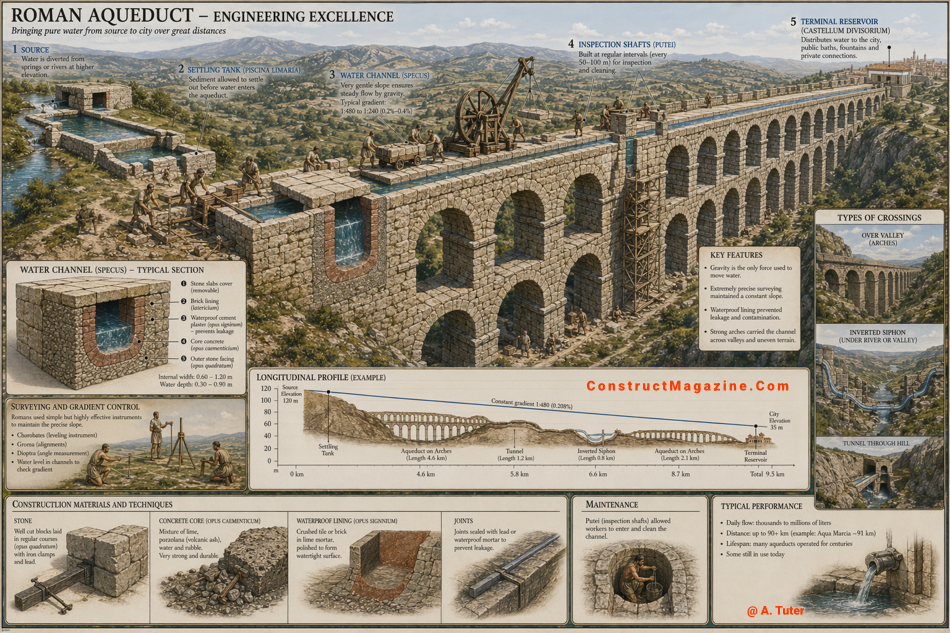
Surveying and Hydraulic Design:
Aqueducts operated on gravity flow within open channels (there are two types of water flow; open channel and pressurized) with the exception of “inverted siphon” locations and some downstream pipes in the city where pressurized flow is maintained. Inverted siphon is a system that is used to cross deep valleys. In these sections, water flowed down and rose again due to elevation-induced pressure.
To maintain continuous flow in these non-pressurized open channels over long distances, extremely precise shallow slopes of as low as 0.1% – 0.2% were maintained overall. Instruments such as the chorobates allowed accurate leveling over extended distances.
Although arched bridges are the most recognizable feature, they represented only a small portion of the system. Most aqueducts ran underground, protecting the water and improving durability. Arcades were used only where necessary to cross valleys or uneven terrain.
The water channel (specus) was lined with waterproof mortar containing volcanic ash (pozzolana), forming a durable hydraulic lining that minimized leakage. Systems also included settling tanks (piscinae limariae) to remove sediment and vertical access shafts (putei) for inspection, ventilation, and maintenance.
Structural Integrity and Foundations:
Maintaining precise gradients required careful control of foundation behavior. Roman engineers mitigated differential settlement, which could damage the channel and disrupt flow. In weaker soils, timber piles were used to improve support conditions. Imagine this for a second… We are talking about building against differential settlement over highly variable terrain, to maintain a permanent, precise slope on the order of as low as 0.1%, at a time when humanity still had to wait nearly 2000 years to develop formal soil mechanics and settlement calculations. Just the foundation system of Roman aqueducts—leaving everything else aside—is one of the greatest engineering achievements of all time.
Specialized Distribution:
At the city, water entered the castellum divisorium, where it was distributed through lead, terracotta, or stone pipes. The distribution system was so advanced that even in some rich people’s homes, pressurized water was available.
Conclusion:
Aqueducts were expensive to build and maintain. They were not built for us to watch in awe 2000 years later but only when needed for large settlements. Smaller settlements often relied on wells and cisterns.
The scale and precision of Roman aqueducts without having today’s knowledge, technology and equipment, represent one of history’s greatest engineering achievements until the modern era.
Post By: A. Tuter
Terms of Use: Unauthorized copying is prohibited; we maintain dated records to document original publication. Content may contain inaccuracies. See our Terms Page.