Retaining Structures and Types
The primary functions of a retaining structure are:
Separate an area of low elevation from an adjacent higher elevation area
Prevent slope failure or soil movement
Create usable land on sloped terrain
Support excavations
Protect infrastructure such as roads and buildings
Retaining structures do this by resisting lateral earth pressure generated by the retained soil or prevent it from collapsing by anchoring into them or reinforcing them. In addition to soil lateral pressure, there may also exist loads such as surcharge loads such as from buildings vibrations caused by vehicles, and earthquake loads.
Selecting the appropriate retaining system requires evaluating several key factors, including the height and extent of the elevation to be retained, the properties of the soil to be retained, available construction space and site access, groundwater conditions, and the presence of nearby underground utilities or structures. For all elevation retention works, where space permits, a sloped excavation should also be assessed as a viable alternative.
Retaining structures are of several main types:
Gravity Walls, Cantilever Walls, Counterfort/Buttress Walls, Anchored Walls, Mechanically Stabilized Earth (MSE) Walls, Slurry Walls, Sheet Pile Walls, Tangent/Secant Walls, Soldier Piles and Lagging, Crib Walls, Gabions. There are also reinforced earth slopes, which serve mostly same purposes but they work by reinforcing the earth itself rather than retaining it as a wall.
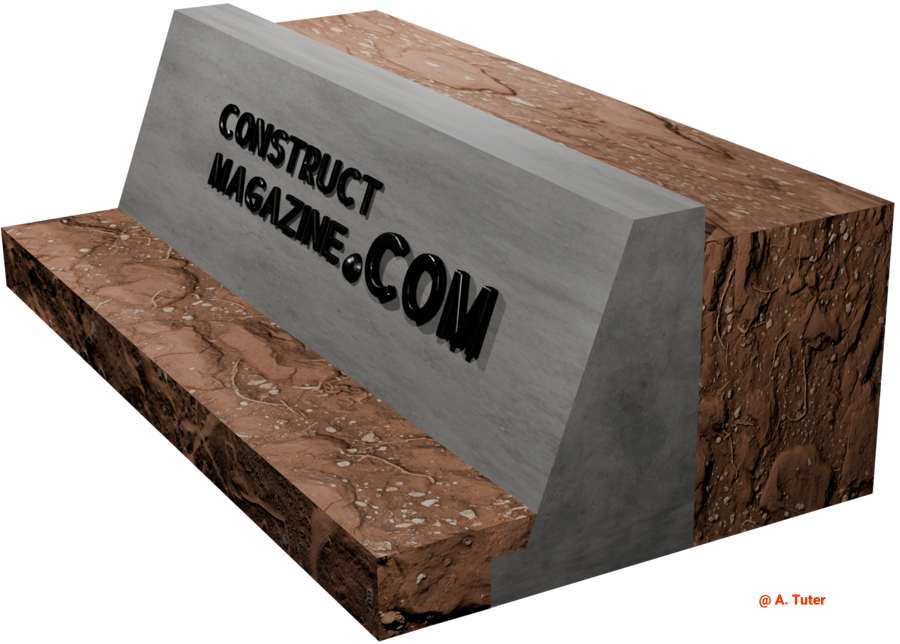
Gravity and cantilever retaining walls both rely on gravity for stability. For a gravity wall the stabilizing weight is from the wall itself, whereas for a cantilever wall the stabilizing force results from the weight of the retained earth itself. Counterfort and buttress walls are simply types of cantilever wall, where the wall is braced by buttresses or counterforts, which also add considerable weight to the wall, and therefore they can be considered to work partly as gravity and partly as cantilever walls.

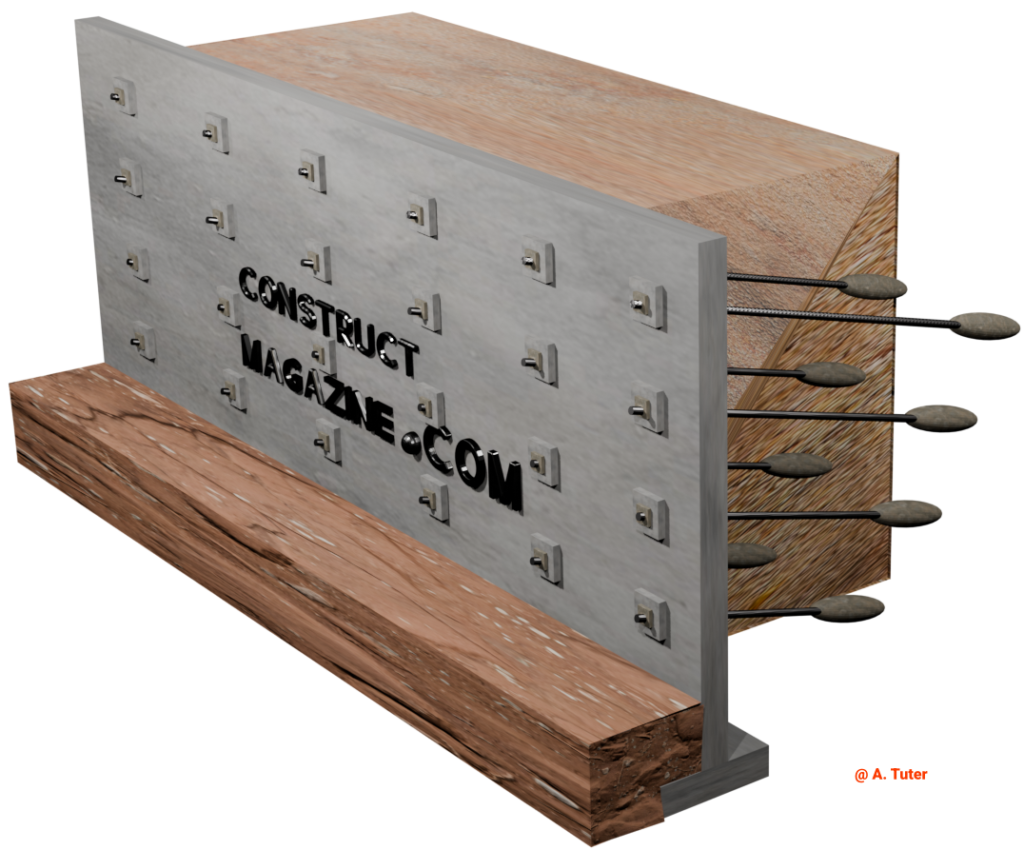
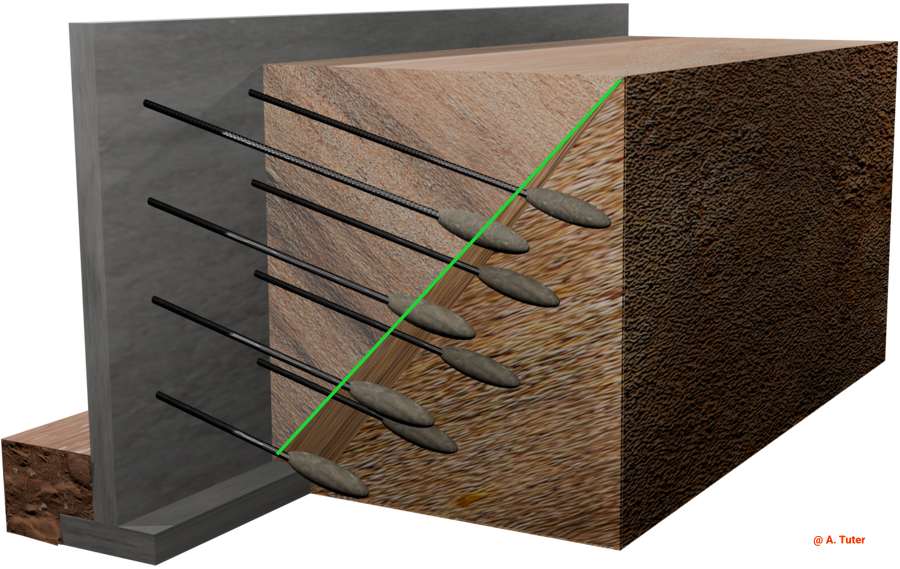
Anchored Wall system. It works by the anchors extending into the soil providing stabilizing resistance. The anchors must reach beyond the active wedge line, marked by green in the image.
Post By: A. Tuter
Terms of Use: Unauthorized copying is prohibited; we maintain dated records to document original publication. Content may contain inaccuracies. See our Terms Page.